

The After-School Maghrib Routine That Actually Works for Muslim Families
School bags hit the floor. Someone is hungry. Someone is loud. Someone wants a screen right now. And Maghrib is either already in or minutes away.
If that sounds like your house, you are not failing. You are living a real Muslim parenting afternoon.
This guide gives you a simple after-school Maghrib routine that actually fits busy homes: about 20 minutes, clear steps, age bands, and words you can say tonight. No perfection required. Just a calm reset that teaches your children that Maghrib is how our family comes back to Allah—and to each other.
Why Maghrib Is the Perfect After-School Anchor
Maghrib sits right in the hardest pocket of the day: tired kids, tired parents, homework waiting, dinner not ready, and phones calling everyone’s name.
That is exactly why it works as an evening routine for Muslim kids.
- It already has a fixed time (you don’t invent a new “family meeting”).
- It includes embodied worship—wudu, standing, quiet—which settles bodies better than a lecture.
- It creates a natural screen pause before the night spins out.
- It builds identity: “In our home, we stop for Maghrib.”
The Prophet ﷺ taught the importance of praying on time, and he encouraged praying in congregation when possible. At home, praying Maghrib together is one of the most loving, low-pressure ways to live that spirit—without turning your living room into a lecture hall.
Soft note: This is parenting guidance, not a fatwa. Follow the prayer rulings of the scholars you trust. Adapt the routine to your madhhab, work hours, and children’s needs.
The Big Idea: A 20-Minute Maghrib Reset
Forget a perfect hour-long program. Aim for this flow:
- Arrive & soft reset (0–5 min)
- Wudu together (5–8 min)
- Maghrib together (8–15 min)
- Connect & protect (15–20 min)
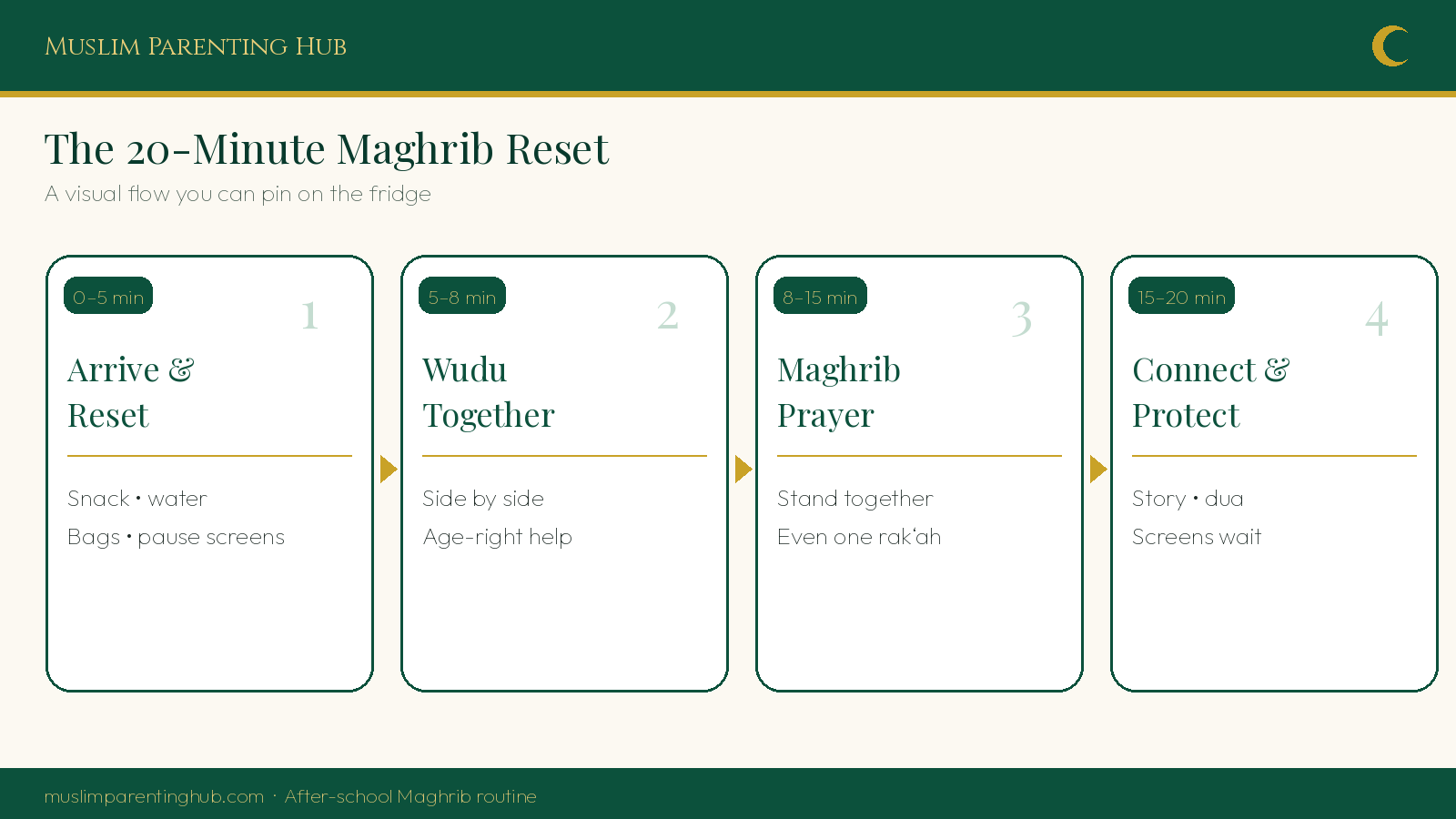
Pin that image on the fridge. Kids love seeing the map. Parents love having fewer decisions when everyone is hungry.
Step 1 — Arrive & Soft Reset (First 5 Minutes)
Do not open with “Go pray.” Open with relief.
Hungry, overstimulated children do not hear spiritual invitations well. A soft reset makes Maghrib feel like care, not a command barked from the kitchen.
The 3-part landing
- Shoes & bags — park them in the same spot every day
- Snack + water — keep it boring and ready
- Screen pause — phones/tablets go to the charging basket
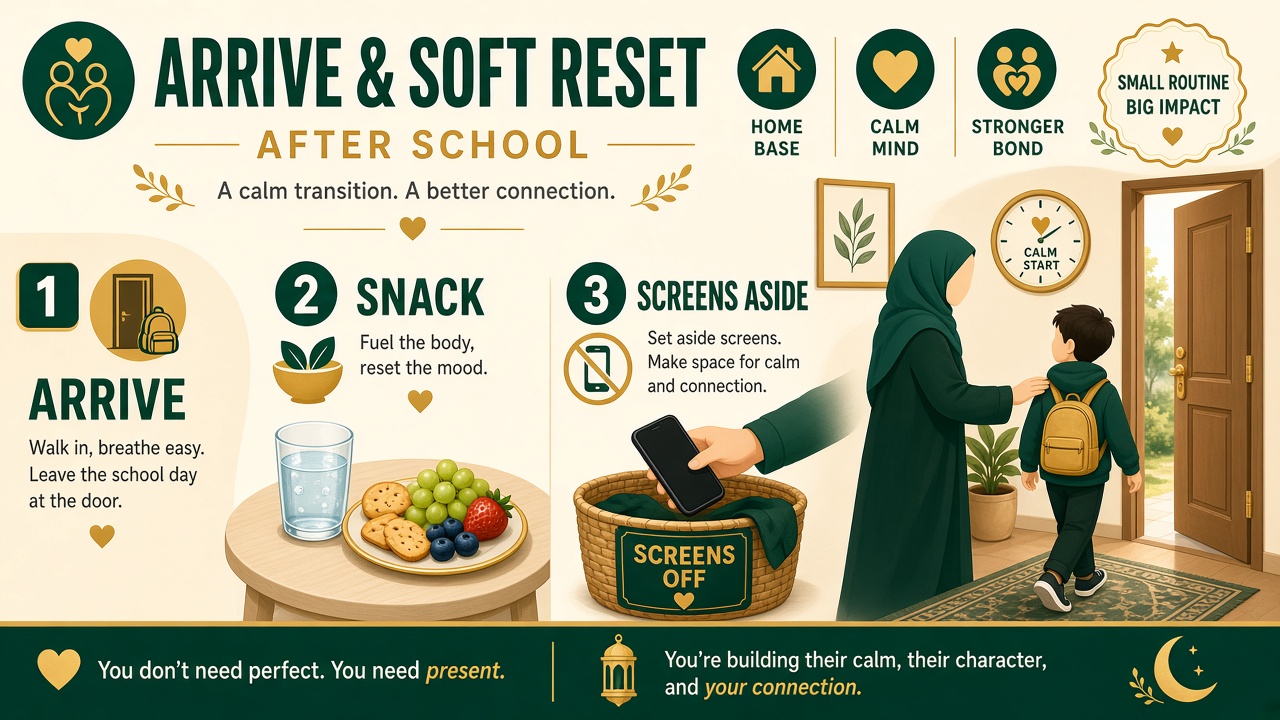
Snack ideas that don’t wreck salah
- Dates and water
- Apple slices or banana
- Yogurt cup
- Toast with something simple
- A small handful of nuts (age-safe)
Save big meals for after Maghrib when you can. A light snack removes the “I’m starving” meltdown without turning prayer into “after we finish a full dinner and three shows.”
Tonight you can say
“Assalamu alaykum—shoes off, water first. Screens sleep in the basket until after Maghrib. We’re resetting together.”
Age tweaks
| Age | What helps |
|---|---|
| Toddler (2–3) | Hand them the water bottle. Let them “put” one shoe on the mat. Expect mess; praise effort. |
| Preschool (4–5) | Give a job: “You’re the bag captain.” Offer two snack choices max. |
| School-age (6–12) | They run their own landing checklist. Your job is consistency, not micromanaging. |
Step 2 — Wudu Together (Make It Warm, Not Military)
Wudu is purification—and for kids, it can also be regulation. Cool water, repeated motions, standing beside you: it settles the nervous system.
Keep the tone light. You are inviting them into a Sunnah habit, not grading their technique.

Age-band wudu guide
Toddler (2–3)
- You do wudu; they watch, splash gently, copy hands.
- Name body parts with barakah language: “Hands we use for dua.”
- End with smile + “Alhamdulillah.”
- Related later guide: How to Teach Wudu to Preschoolers (Gentle & Fun) ← internal link placeholder: wudu preschool post
Preschool (4–5)
- They try hands and face with help.
- Use a small stool so the sink feels theirs.
- Praise effort: “You remembered your mouth—mashaAllah.”
- Skip shame about wet sleeves. Have a dedicated “wudu towel.”
School-age (6–12)
- They lead their own wudu while you do yours beside them.
- Quiet check-in: “Did we finish?”
- If they rush, model slower breathing—not a lecture.
Tonight you can say
“Come wash with me. We don’t need perfect. We need ready hearts.”
Optional one-line reminder (soft aqidah, not scare):
“Wudu washes for salah—and it helps our bodies feel calm for Allah.”
Step 3 — Maghrib Together (Short, Warm, Doable)
This is the heart of the Maghrib with children habit: stand together, even on messy days.

A simple Maghrib-together sequence
- Adhan cue — pause voices; someone can repeat soft phrases if you like
- Mats out — kids help unroll (ownership beats nagging)
- Iqamah — stand side by side; toddler can hold a soft toy on the mat edge if needed
- Pray — parent leads; kids join for what they can
- After — hug + one short dua line
What “joining” looks like by age
- Toddler: On the mat nearby, copying bows in bursts, wandering allowed within a gentle boundary
- Preschool: Stands for parts, sits when tired, rejoins for sujood when possible
- School-age: Prays with you; if they’re learning, let them lead a short sunnah later for confidence
Hard-day rule (keep this)
On the hardest days, protect the minimum:
You pray Maghrib on time, and your child is present in the room / on a mat—even for one rak‘ah of connection.
Consistency beats intensity. A child who stands with you most Maghribs of the year learns identity. A child who only experiences long, tense “perfect” prayers learns dread.
Tonight you can say
“School is done. Maghrib is our reset. Come stand with me—even for one rak‘ah.”
Or, if there’s resistance:
“You don’t have to feel like it. You just have to come stand beside me. I’ll take the lead.”
Step 4 — After Maghrib Connection (5–10 Minutes That Save the Night)
The prayer ends. The evening can still collapse into screens, arguing, and homework panic.
So lock a short connection block before the house reopens to devices and noise.

Four tiny practices (pick 2 tonight)
- Story or ayah — one short story, or a single ayah with a kid-friendly meaning
- Feelings check — “What was hard today? What was kind?”
- Screen rule — no screens until the homework/Isha plan is clear
- Family dua — each person whispers one dua from the heart
Related later guides (internal link placeholders):
- Teach Your Child to Make Dua From the Heart — dua from heart post
- When Your Muslim Toddler Fights Bedtime — bedtime struggles post
- A Simple Friday Night Family Routine — Friday night post
A gentle screen rule after Maghrib
This is where many Muslim homes lose the evening—not because screens are “evil,” but because screens steal the transition.
Try this house line:
“After Maghrib, screens wait until we know the plan: homework, dinner, Isha.”
For school-age kids, write the plan on a whiteboard. Autonomy lowers debate.
If you allow limited screen time later, keep it:
- After the connection block
- After homework expectations are set
- Preferably not in bedrooms
- With a clear off-time before Isha or wind-down
Tonight you can say
“Maghrib done—alhamdulillah. Two minutes for hearts, then we look at homework. Screens stay asleep until we know the plan.”
For dua practice:
“Whisper one thing you want to thank Allah for, and one thing you need help with. I’ll go first.”
Sample Schedules (So You Can Steal One Tonight)
Version A — Classic school-day Maghrib at home
| Time | Action |
|---|---|
| Walk-in | Salam, shoes, bags, water |
| +3 min | Snack |
| +5 min | Wudu together |
| Adhan / due time | Maghrib together |
| + after salah | 5-minute connect (ayah/feelings/dua) |
| Then | Dinner prep / homework plan; screens still paused |
Version B — Maghrib falls during pickup / commute
- Parent A prays at the earliest valid time (mosque, quiet corner, home).
- Parent B does a mini Maghrib with kids at home as soon as everyone lands: snack → wudu → pray.
- Later: one shared dua on the couch so the family meaning still sticks.
Version C — One parent working late
- The available parent runs Steps 1–4.
- When the late parent arrives, kids greet with salam and a 30-second “Maghrib highlight” (“We prayed; I made dua for Grandma”).
- Identity stays family-shaped even when timings differ.
Scripts Library (Copy-Paste Calm)
Use these verbatim. Soft voice. Same words daily. Predictability is half the parenting win.
On resistance
“I hear you. Maghrib still happens. Stand next to me; you can be quiet.”
On sibling fighting mid-routine
“Fight pause. Mats out. We can talk after Maghrib—Allah first.”
On “I’m not Muslim tonight” / big feelings
“Your feelings are welcome. Our salah still holds us. Come sit on the mat; I’ll pray, you can breathe with me.”
On screens begging
“Screens after Maghrib connection. That’s our house rule—same every day.”
On praise (fuel the habit)
“I loved how you put your phone in the basket without me asking. That is real adab.”
Common Problems (And Calm Fixes)
“They only pray when I yell.”
Yelling becomes the cue. Replace volume with environment cues: adhan audio, mats already visible, snack ready, charging basket by the door. Change the path of least resistance.
“My toddler wrecks every salah.”
Success = presence + warmth, not stillness. Use a prayer corner with a soft boundary (shelf, tape line). Offer a quiet book for after their “copying burst.” Celebrate rejoining for sujood.
“Homework collides with Maghrib.”
Homework waits for the reset. Ten focused minutes after Maghrib beat forty distracted minutes before it. Say: “Brains pray first; then brains work.”
“We’re exhausted and skip it together.”
Protect a floor routine: you pray; kids sit on mats with water. Rebuild togetherness tomorrow. Shame is not a strategy.
“Weekends destroy the habit.”
Keep Maghrib-together even if everything else is loose. Habits survive on anchors, not perfect schedules.
A 7-Day Starter Plan (Low Friction)
- Day 1–2: Only Step 1 + you praying Maghrib on time while kids are in the room
- Day 3–4: Add side-by-side wudu
- Day 5–6: Kids on mats for Maghrib (any participation counts)
- Day 7: Add a 3-minute after-Maghrib dua/feelings check
Do not launch the full fancy version on a chaotic Tuesday. Stack wins.
Printable Mentality Checklist (Fridge Version)
- [ ] Bags & shoes parked
- [ ] Water + light snack
- [ ] Screens in basket
- [ ] Wudu together
- [ ] Maghrib together (even short)
- [ ] One connect: story / feelings / dua
- [ ] Evening plan spoken out loud
- [ ] Screens only after the plan
FAQ: Maghrib Evening Routine for Muslim Families
What is a good Maghrib evening routine for Muslim kids?
A good routine is short and repeatable: arrive and snack, pause screens, make wudu together, pray Maghrib as a family, then spend a few minutes connecting before homework or devices. About 20 minutes is enough for most homes.
How do I pray Maghrib with children who won’t stay still?
Invite presence over perfection. Toddlers can copy some movements and wander within a gentle boundary. Preschoolers may join parts of the prayer. Keep your own salah calm and consistent; children learn from your steadiness more than from long corrections.
Should Muslim kids have screens after Maghrib?
Many families do better with a clear rule: no screens until after Maghrib and a short connection/homework plan. Limited screens later can work if they don’t erase Isha, sleep, or family time. The key is a predictable house rule, not nightly negotiations.
What if Maghrib time is different for each parent’s work schedule?
Pray on time individually when needed, then protect a shared family moment—either Maghrib with whoever is home, or a later dua/story circle when everyone reunites. The habit is “we return to Allah together,” not identical clocks.
How can I make wudu easier for preschoolers?
Use a stool, a dedicated towel, short steps, and lots of praise. Let them do hands and face with help. Keep it playful and shame-free. A future MPH guide on gentle preschool wudu will go deeper—Wudu for Preschoolers.
What should we do after Maghrib before bedtime?
Keep a light sequence: connection (ayah, feelings, or dua), dinner/homework plan, Isha according to your timing, then a calm bedtime wind-down. If bedtime is a struggle, see our related guide on Muslim toddler bedtime struggles.
How do we keep Fridays special without losing Maghrib?
Keep the Maghrib reset, then add one Friday-night joy (family game, Surah Al-Kahf in a kid-friendly way, or a gratitude round). Details will live in Friday night Muslim family routine.
Closing: Start Tonight, Not “Next Month”
You do not need a perfect Islamic home aesthetic to give your children a Maghrib they remember.
You need a door ritual, a snack, wet hands beside yours, a shared mat, and one kind sentence after salah.
Tonight is enough:
- Put out the charging basket
- Prep one snack
- Say the reset line when they walk in
- Pray Maghrib with whoever will stand with you
May Allah make Maghrib the softest part of your family’s day—and make your children love standing beside you. Ameen.
Published for Muslim Parenting Hub · Practical faith at home · English guide for parents of toddlers, preschoolers, and school-age kids
FAQs
What is a good Maghrib evening routine for Muslim kids?
A good routine is short and repeatable: arrive and snack, pause screens, make wudu together, pray Maghrib as a family, then spend a few minutes connecting before homework or devices. About 20 minutes is enough for most homes.
How do I pray Maghrib with children who won’t stay still?
Invite presence over perfection. Toddlers can copy some movements and wander within a gentle boundary. Preschoolers may join parts of the prayer. Keep your own salah calm and consistent; children learn from your steadiness more than from long corrections.
Should Muslim kids have screens after Maghrib?
Many families do better with a clear rule: no screens until after Maghrib and a short connection or homework plan. Limited screens later can work if they don’t erase Isha, sleep, or family time. Use a predictable house rule instead of nightly negotiations.
What if Maghrib time is different for each parent’s work schedule?
Pray on time individually when needed, then protect a shared family moment—either Maghrib with whoever is home, or a later dua or story circle when everyone reunites. The habit is returning to Allah together, not identical clocks.
How can I make wudu easier for preschoolers?
Use a stool, a dedicated towel, short steps, and lots of praise. Let them do hands and face with help. Keep it playful and shame-free.
What should we do after Maghrib before bedtime?
Keep a light sequence: connection (ayah, feelings, or dua), dinner or homework plan, Isha according to your timing, then a calm bedtime wind-down.
How do we keep Fridays special without losing Maghrib?
Keep the Maghrib reset, then add one Friday-night joy such as a family game, a kid-friendly Surah Al-Kahf moment, or a gratitude round.