

Teach Your Child to Make Dua From the Heart (Not Just Memorized Lines)
Your child can recite a beautiful dua at bedtime… and still feel alone with a scary thought at 2 a.m.
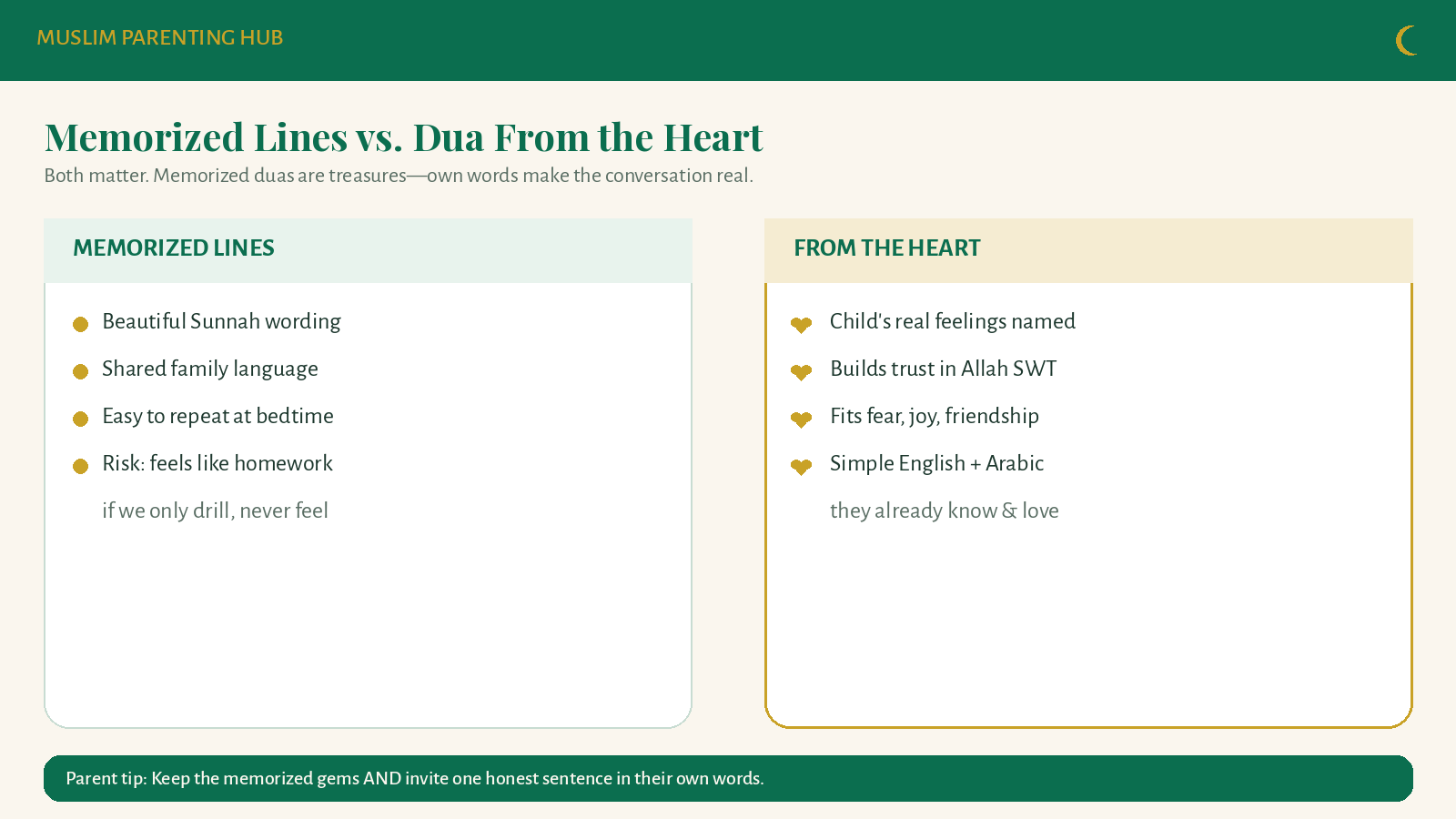
Memorized lines are a gift. They connect us to the Sunnah, give the family shared words, and make dua easy when feelings are big. But if dua only sounds like homework—“say it again, correctly”—children may learn performance instead of relationship.
This guide shows you how to teach kids dua in their own words: a gentle method, age bands, an own-words formula, and Muslim kids dua scripts you can use tonight for fear, gratitude, and friendship. Soft parenting guidance—not a fatwa. Adapt to your family’s scholars, language, and child’s personality.
Why “Dua From the Heart” Matters for Muslim Kids
Dua is conversation with Allah. The Prophet ﷺ taught that dua is worship, and he made dua in moments of need, gratitude, and everyday life—not only in formal settings.
For children, the goal is not eloquent Arabic on day one. The goal is:
- Safety — “I can tell Allah anything.”
- Identity — “Muslims talk to Allah.”
- Regulation — naming a feeling + asking for help calms the body.
- Connection — parent and child turn toward Allah together.
Memorized duas and own-words duas are not rivals. Think of them as two hands: one holds the treasures of tradition; the other reaches with today’s real heart.
Soft note: This is practical Muslim parenting guidance, not a religious ruling. For specific fiqh questions about dua wording, timing, or manners, ask a trusted local scholar or teacher.
How to Teach Children to Make Dua (3 Soft Steps)
You do not need a curriculum. You need a repeatable micro-habit under two minutes.
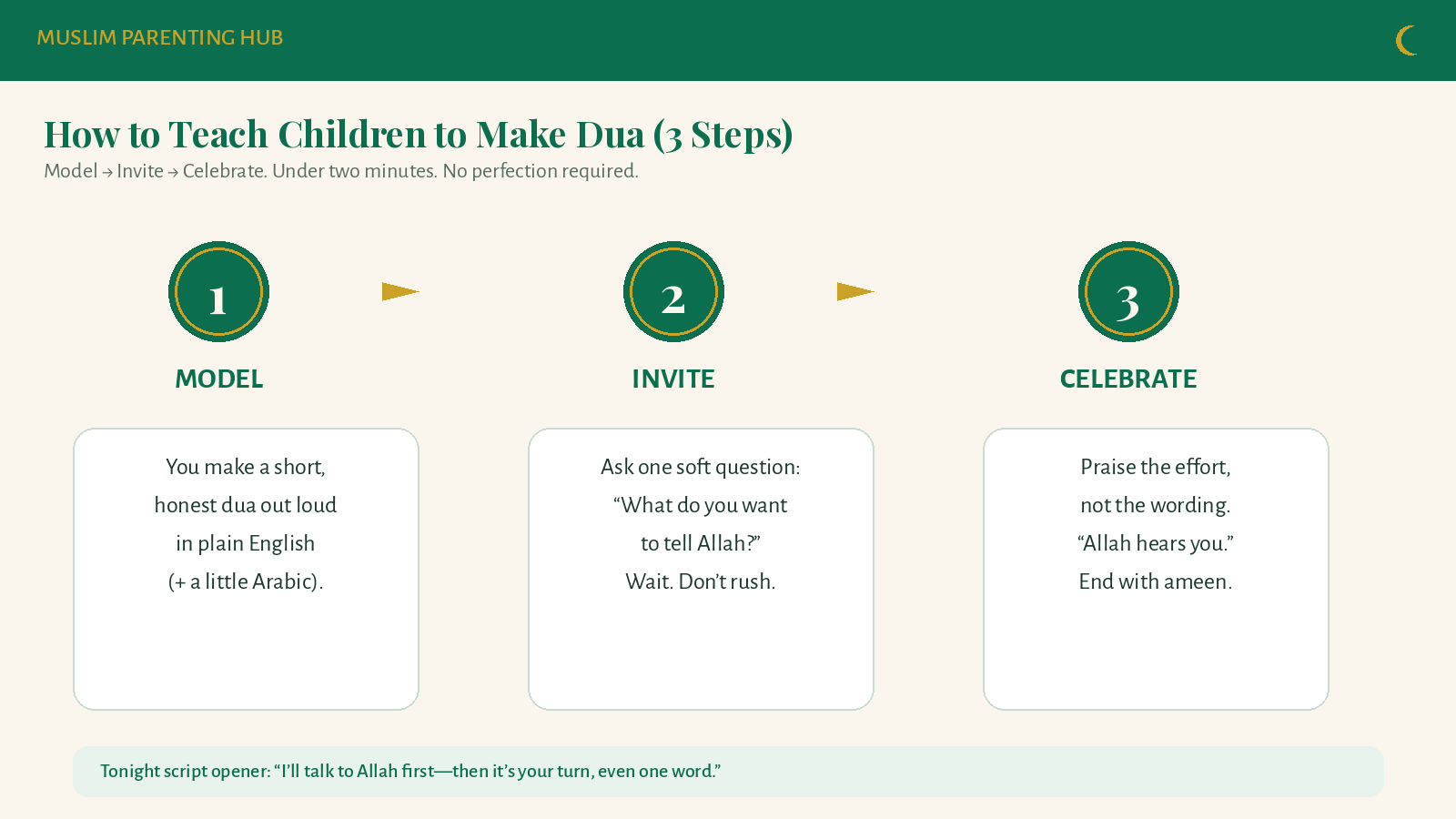
Step 1 — Model
You speak first, out loud, in plain English with a little Arabic your child already knows (Ya Allah, Alhamdulillah, Ameen).
Keep it short. Keep it honest. Kids copy tone more than vocabulary.
Step 2 — Invite
Ask one soft question—then wait.
- “What do you want to tell Allah?”
- “What are you thankful for?”
- “Who should we make dua for?”
Silence is okay. One word is okay. A shrug is data, not failure.
Step 3 — Celebrate
Praise effort, not grammar.
“Allah hears you. MashaAllah for talking to Him.”
Then say Ameen together.
Tonight you can say
“I’ll talk to Allah first—then it’s your turn, even one word.”
Pair this with your evening calm. Many families tuck a short dua into Maghrib connection time—see our guide to an After-School Maghrib Routine for Muslim Families.
A Simple Own-Words Dua Formula
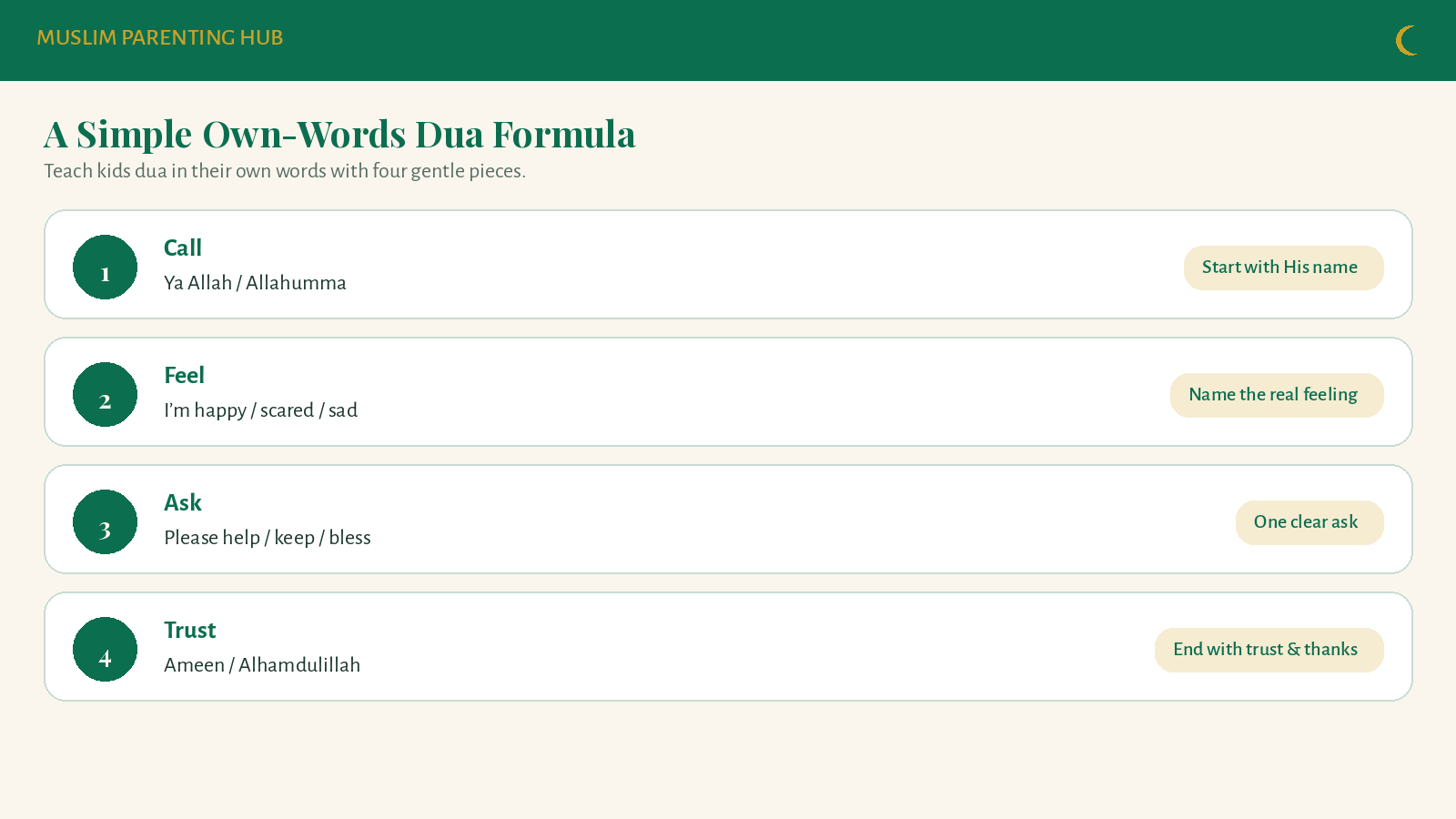
When children freeze, give them a four-piece pattern. It teaches kids dua in their own words without forcing a speech.
- Call — Ya Allah / Allahumma
- Feel — I’m happy / scared / sad / excited
- Ask — Please help / keep / bless / heal
- Trust — Ameen / Alhamdulillah
Example (child, preschool):
“Ya Allah, I’m scared. Please keep me safe. Ameen.”
Example (school-age):
“Ya Allah, I felt left out at recess. Please help my heart feel calm and help me be kind. Alhamdulillah. Ameen.”
You can still teach classic duas (Rabbana atina…, bedtime adhkar, istiftah). Own-words practice sits beside memorization—not against it.
Age Bands: What “From the Heart” Looks Like
Same destination. Different expectations.
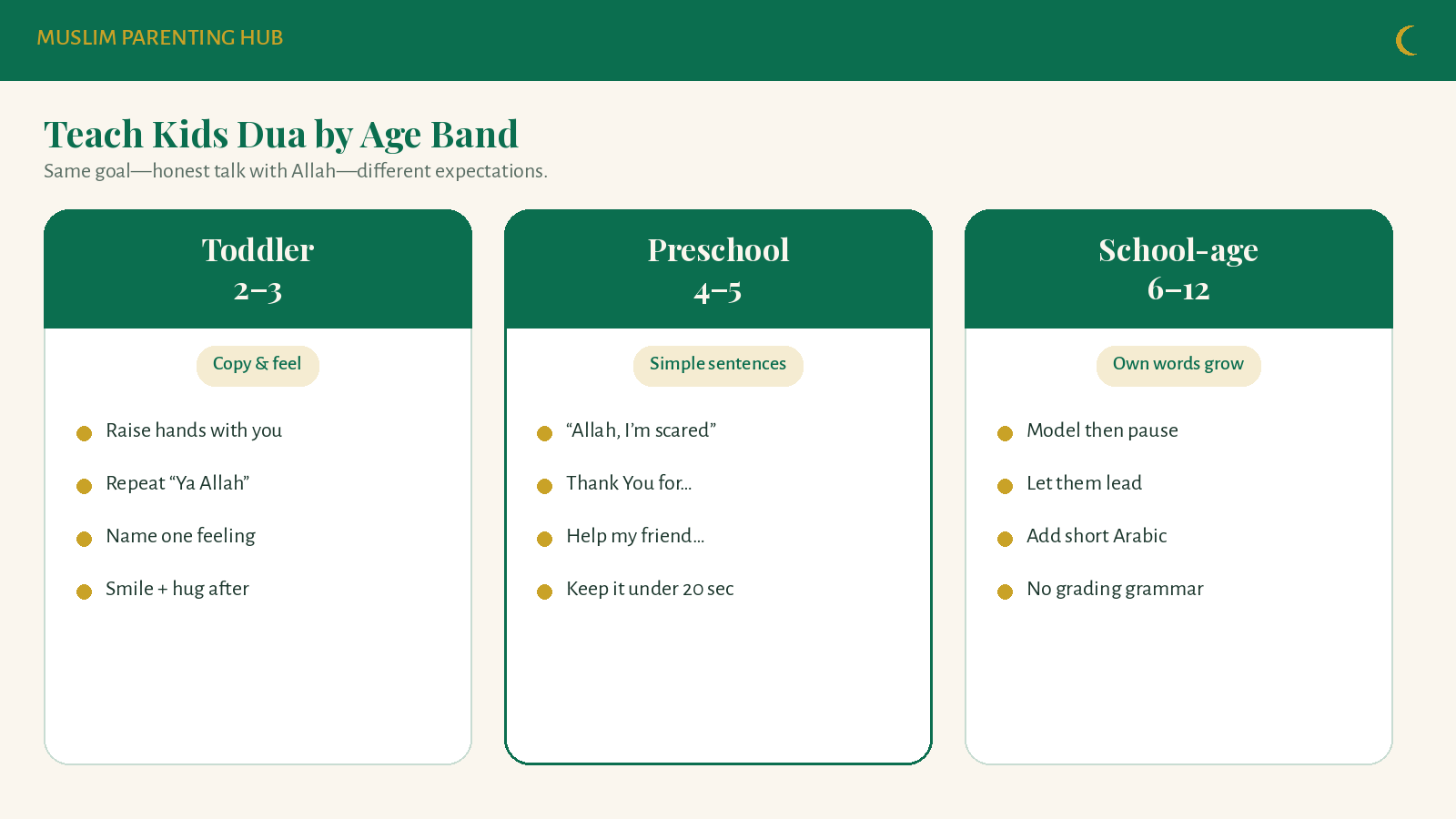
Toddler (2–3): Copy & feel
- Raise hands with you (even briefly).
- Repeat Ya Allah or Ameen.
- You name the feeling for them: “You’re tired. Let’s tell Allah.”
- End with smile + hug. Worship should feel warm.
Parent model:
“Ya Allah, keep our baby safe and calm. Ameen.”
Preschool (4–5): Simple sentences
- Invite one sentence using Call → Feel → Ask.
- Keep total dua under ~20 seconds.
- Accept mixed English + Arabic.
- Avoid correcting mid-dua; coach gently afterward if needed.
Parent invite:
“What do you want to thank Allah for tonight?”
School-age (6–12): Own words grow
- Model, then pause so they can lead.
- Add short Arabic phrases they know.
- Never grade sincerity or grammar.
- Link dua to real life: tests, friends, sports, screens, siblings.
Parent coaching (after, not during):
“I loved how you told Allah how you felt. Next time you can also say Ya Allah at the start if you want.”
Related habit building: bathroom manners and simple protective duas also grow with age—see Islamic Potty Training: Toilet Manners, Duas & Taharah Tips.
Tonight Scripts: Fear, Gratitude & Friendship
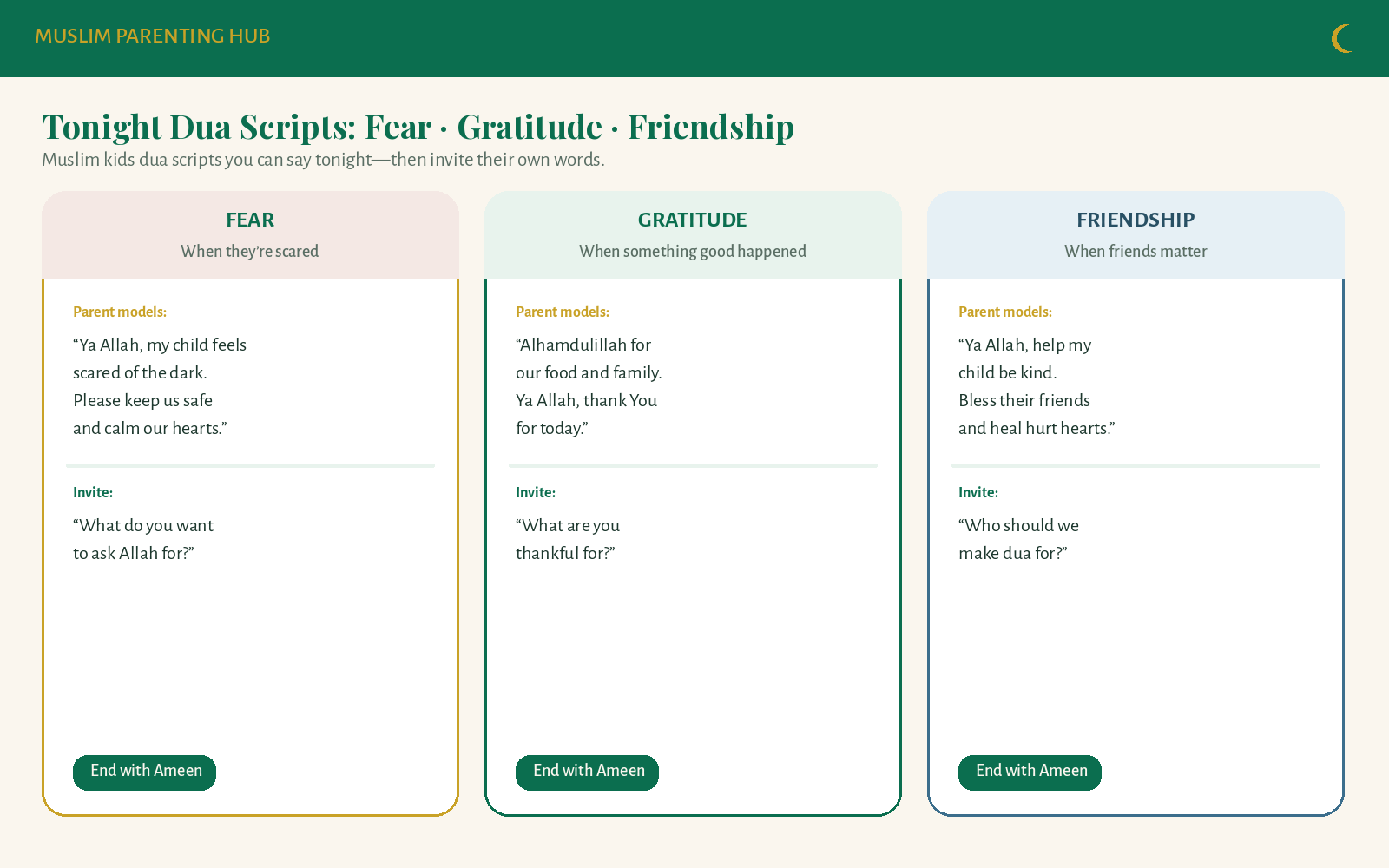
These Muslim kids dua scripts are starters—not scripts to force word-for-word. You model; they answer in their own words.
1) Fear (dark, nightmares, new places)
Parent models:
“Ya Allah, my child feels scared of the dark. Please keep us safe and calm our hearts. You are Al-Hafiz—the Protector. Ameen.”
Invite:
“What do you want to ask Allah for?”
Child-friendly own-words options:
- “Ya Allah, I’m scared. Please stay with me.”
- “Allah, make the scary thoughts go away.”
- “Ya Allah, keep Mama/Baba close and keep me safe.”
Optional Arabic they may already know: A‘udhu billahi min ash-shaytan ir-rajeem (I seek refuge in Allah from Shaytan). Soften it: explain it as “We ask Allah to protect us.”
2) Gratitude (food, wins, ordinary blessings)
Parent models:
“Alhamdulillah for our food and family. Ya Allah, thank You for today. Please put barakah in our home. Ameen.”
Invite:
“What are you thankful for?”
Child-friendly options:
- “Ya Allah, thank You for my bike / teacher / baby sibling.”
- “Alhamdulillah for snacks and sunshine.”
- “Ya Allah, thank You I scored a goal—and help me stay humble.”
Gratitude dua after Maghrib or Friday night dinner is a lovely family ritual. (Friday-night family routine guide coming soon.)
3) Friendship (kindness, conflict, loneliness)
Parent models:
“Ya Allah, help my child be kind. Bless their friends and heal hurt hearts. Make us people who forgive. Ameen.”
Invite:
“Who should we make dua for?”
Child-friendly options:
- “Ya Allah, bless my friend ____.”
- “Allah, help us stop fighting and say sorry.”
- “Ya Allah, if I feel left out, help my heart and help me find kind friends.”
If friendship drama is fueled by apps or videos, pair dua with wiser media habits—see YouTube Kids Setup for Muslim Parents.
Arabic + English: Keep It Natural
You do not need a bilingual lecture. Weave in words your child already hears:
| Arabic | Soft meaning for kids |
|---|---|
| Ya Allah | “O Allah” — we call Him |
| Allahumma | “O Allah” — a loving call |
| Alhamdulillah | “All praise is for Allah” |
| Ameen | “O Allah, accept this” |
| Rabbana | “Our Lord” |
| Astaghfirullah | “I ask Allah to forgive me” |
A gentle mix example:
“Ya Allah, I’m nervous about the test. Please help me remember and stay calm. Alhamdulillah. Ameen.”
If your home language is Urdu, Turkish, Somali, or another tongue, own-words dua in that language is still dua from the heart. Allah hears every language.
Common Mistakes (And Kinder Swaps)
| Instead of… | Try… |
|---|---|
| “Say it properly.” | “Allah already heard your heart. Want to add Ameen with me?” |
| Forcing a long memorized list when they’re melting down | One feeling + one ask + hug |
| Correcting Arabic mid-sentence | Model the correct phrase next time |
| Making dua a public performance for guests | Keep most practice private and cozy |
| Only dua when someone is in trouble | Also dua for joy, food, friends, and ordinary Tuesdays |
| Shame after a “wrong” word | “MashaAllah for talking to Allah.” |
Where Own-Words Dua Fits in the Day
Sprinkle, don’t dump:
- After Maghrib — 60–90 seconds of family dua (ties to your Maghrib reset).
- Bedtime — one memorized dua + one own-words sentence.
- Car rides — “Quick dua for safety?”
- Before school — “Ya Allah, help me be kind and brave.”
- After conflict — cool bodies first, then a short dua for soft hearts.
A Friday-night family routine can include a longer gratitude round—placeholder for that guide: A Simple Friday Night Family Routine (coming soon).
FAQs
How do I teach my child to make dua in their own words?
Model a short honest dua, invite one sentence (“What do you want to tell Allah?”), and celebrate effort. Use the Call → Feel → Ask → Trust formula when they freeze. Keep sessions under two minutes.
Should Muslim kids memorize duas or speak freely?
Both. Memorized Sunnah duas are treasures and shared family language. Own-words dua builds a living relationship with Allah. Do not treat them as either/or.
What are good Muslim kids dua scripts for bedtime?
Model something like: “Ya Allah, thank You for today. Please keep us safe while we sleep and wake us on good. Ameen.” Then ask: “What do you want to tell Allah before sleep?”
How do I teach a toddler to make dua?
Toddlers copy. Raise hands together, say Ya Allah, name one feeling for them, and end with Ameen and a hug. Presence beats perfection.
Can children make dua in English?
Yes—many families teach heartfelt dua in English (or their home language) while gradually adding Arabic phrases. Allah hears every language. For detailed rulings on preferred wording, consult a trusted scholar.
What if my child refuses to make dua?
Do not force. Model yourself without pressure. Offer a choice: “Hands up with me, or just listen for Ameen?” Protect warmth; curiosity returns when shame leaves.
How often should we practice own-words dua?
A little, often. One sincere minute most nights beats a long weekly lecture. Link it to Maghrib, bedtime, or car rides.
What dua helps when a child is scared?
Name the fear, ask Allah for safety and calm, and invite the child’s own ask. Example: “Ya Allah, we’re scared. Please keep us safe and calm our hearts. Ameen.” Seek refuge language if your family uses it, explained gently.
Start Tonight (60-Second Plan)
- Sit together after Maghrib or at bedtime.
- You model one short dua (fear, gratitude, or friendship).
- Ask one invite question. Wait.
- Say Ameen together. Smile. Done.
You are not raising a child who only recites. You are raising a child who turns to Allah—with memorized gems and a heart that knows how to speak.
Related reading on Muslim Parenting Hub
- The After-School Maghrib Routine That Actually Works for Muslim Families
- Islamic Potty Training: Toilet Manners, Duas & Taharah Tips
- YouTube Kids Setup for Muslim Parents
- A Simple Friday Night Family Routine ← placeholder (coming soon)
FAQs
How do I teach my child to make dua in their own words?
Model a short honest dua, invite one sentence (“What do you want to tell Allah?”), and celebrate effort. Use the Call → Feel → Ask → Trust formula when they freeze. Keep sessions under two minutes.
Should Muslim kids memorize duas or speak freely?
Both. Memorized Sunnah duas are treasures and shared family language. Own-words dua builds a living relationship with Allah. Do not treat them as either/or.
What are good Muslim kids dua scripts for bedtime?
Model something like: “Ya Allah, thank You for today. Please keep us safe while we sleep and wake us on good. Ameen.” Then ask: “What do you want to tell Allah before sleep?”
How do I teach a toddler to make dua?
Toddlers copy. Raise hands together, say Ya Allah, name one feeling for them, and end with Ameen and a hug. Presence beats perfection.
Can children make dua in English?
Yes—many families teach heartfelt dua in English (or their home language) while gradually adding Arabic phrases. Allah hears every language. For detailed rulings on preferred wording, consult a trusted scholar.
What if my child refuses to make dua?
Do not force. Model yourself without pressure. Offer a choice: “Hands up with me, or just listen for Ameen?” Protect warmth; curiosity returns when shame leaves.
How often should we practice own-words dua?
A little, often. One sincere minute most nights beats a long weekly lecture. Link it to Maghrib, bedtime, or car rides.
What dua helps when a child is scared?
Name the fear, ask Allah for safety and calm, and invite the child’s own ask. Example: “Ya Allah, we’re scared. Please keep us safe and calm our hearts. Ameen.” Seek refuge language if your family uses it, explained gently.