
How to Start Quran With Infants & Toddlers at Home (Listening First)
Before Qaida books, before perfect makharij, before competition medals—there can be love.
Many parents feel behind because their two-year-old isn’t “memorizing.” Reframe: for ages 0–4, listening first is a beautiful, low-pressure sunnah-inspired path. This guide covers when to play Quran, how loud, which short passages to rotate, what to do if kids clown around, and how to avoid turning wahy into background noise wallpaper. Soft guidance—not a fatwa. Follow reciters and teachers you trust for tajweed details.
The Big Idea: Hearts Before Homework
Infants track rhythm and voice. Toddlers absorb melody and emotion. Your job is to make Quran feel like safety and beauty, not a performance exam.
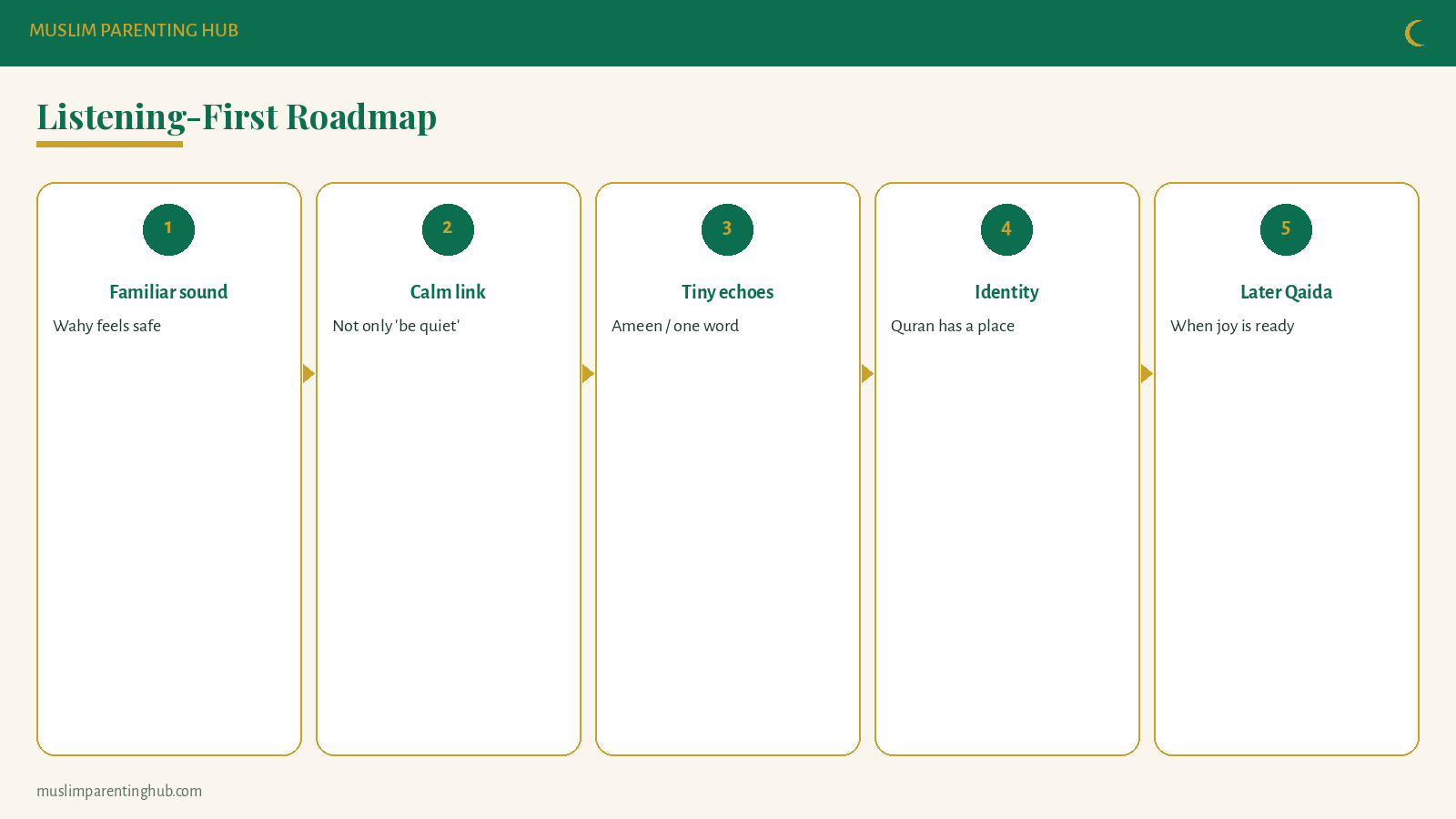
Listening-first goals:
- Familiarity with the sound of revelation
- Calm association (not only “be quiet or else”)
- Tiny echoes (a word, ameen, hands raised)
- Family identity: “In our home, Quran has a place”
Non-goals for this stage: lengthy hifz targets, shame for fidgeting, volume wars with cartoons.
When to Play Quran (Timing That Works)
High-success windows
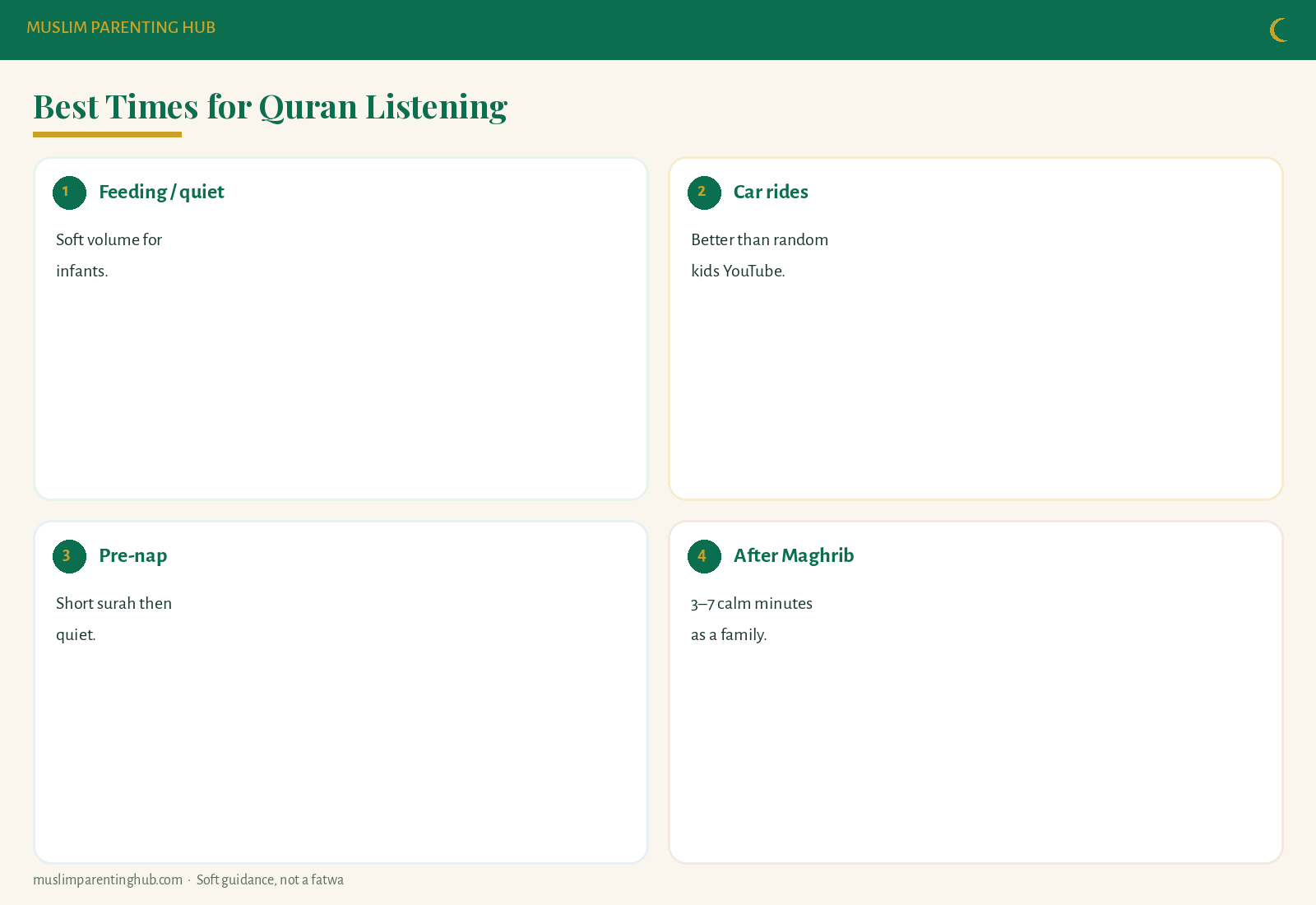
- After sleep / during nursing or bottle (soft volume)
- Car rides (better than random kids’ YouTube—pair with YouTube Kids setup boundaries)
- Pre-nap wind-down (short surah, then quiet)
- After Maghrib connection for 3–7 minutes (Maghrib routine)
- Friday morning micro-listen as part of weekly glow (Friday night routine for evening side)
Lower-success windows
- Peak hunger meltdowns
- Right on top of favorite cartoon (feels like punishment)
- Overnight looping at high volume (sleep disruption; discuss with pediatric guidance if using white-noise style—prefer silence for many babies)
Script: “Quran time—soft ears. We listen with love.”
Volume, Devices, and Adab Basics
- Keep volume conversation-soft—especially for infants’ hearing.
- Prefer a dedicated recitation app/device profile without autoplay into entertainment.
- If using a phone, sit it face-down after starting so the screen doesn’t hijack attention.
- Model adab: don’t shout over ayahs; pause the ayah if you must correct a safety issue, then resume.
- Teach: we don’t throw the device that carries Quran audio; we handle it gently.
This is early reverence—not rigidity.
What to Play: A Simple Rotation (Not a Syllabus)
Rotate short, frequent passages rather than one long juz while toddlers run laps.
Starter rotation ideas:
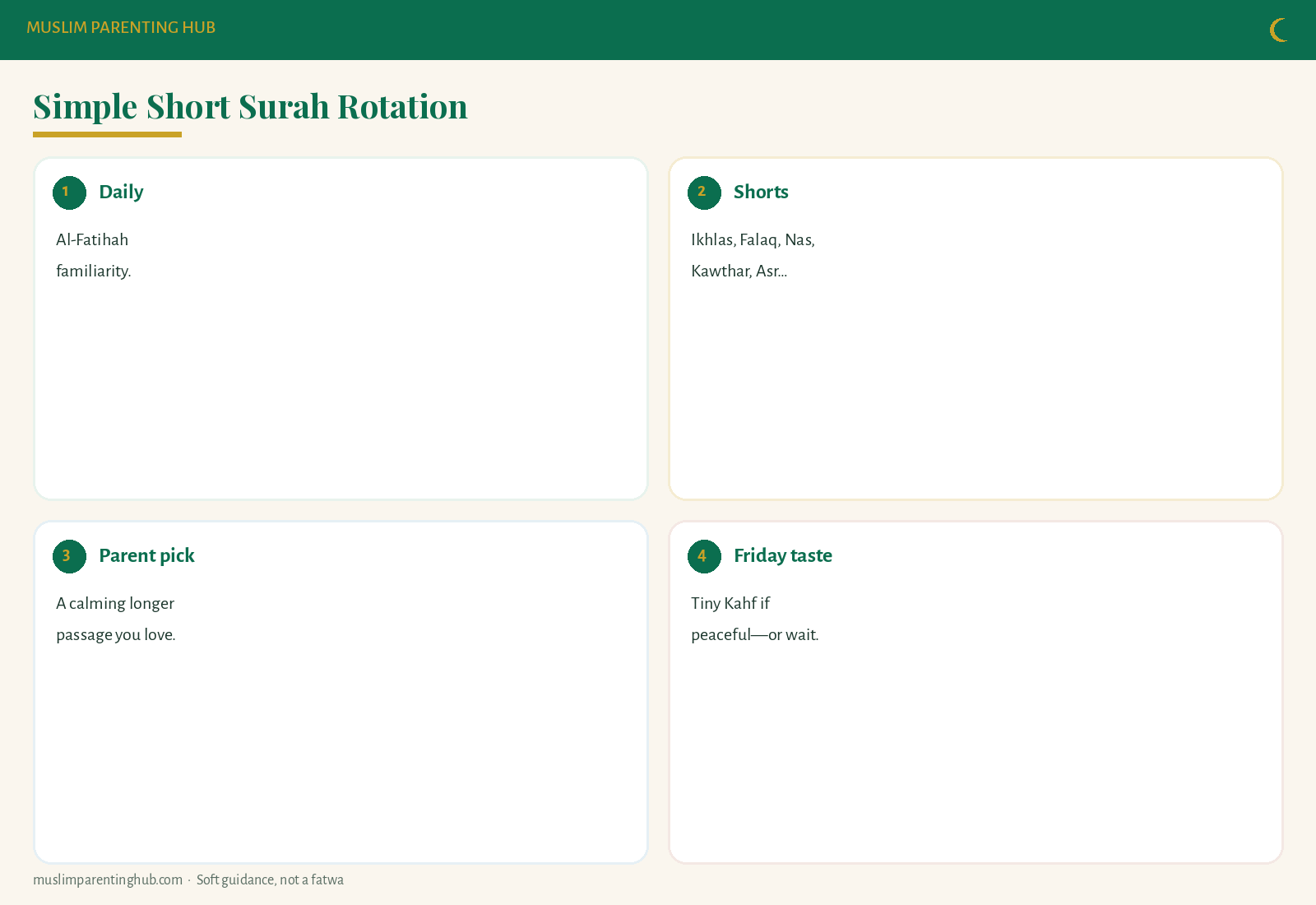
- Al-Fatihah (daily familiarity)
- Short mufassal surahs you love (Ikhlas, Falaq, Nas, Kawthar, Asr…)
- A calming longer passage parent finds soothing (e.g., parts of Mulk / Rahman)—parent choice, not toddler exam
- Friday: a tiny taste of Kahf if it stays peaceful—or save fuller Kahf for older years
Change reciter if a voice feels harsh to your nervous system; children borrow your calm.
Avoid: shock-content videos with scary thumbnails “for kids,” overstimulating cartoon-Quran mashups that train clowning, and arguing about Qira’at at the breakfast table.
Age Bands
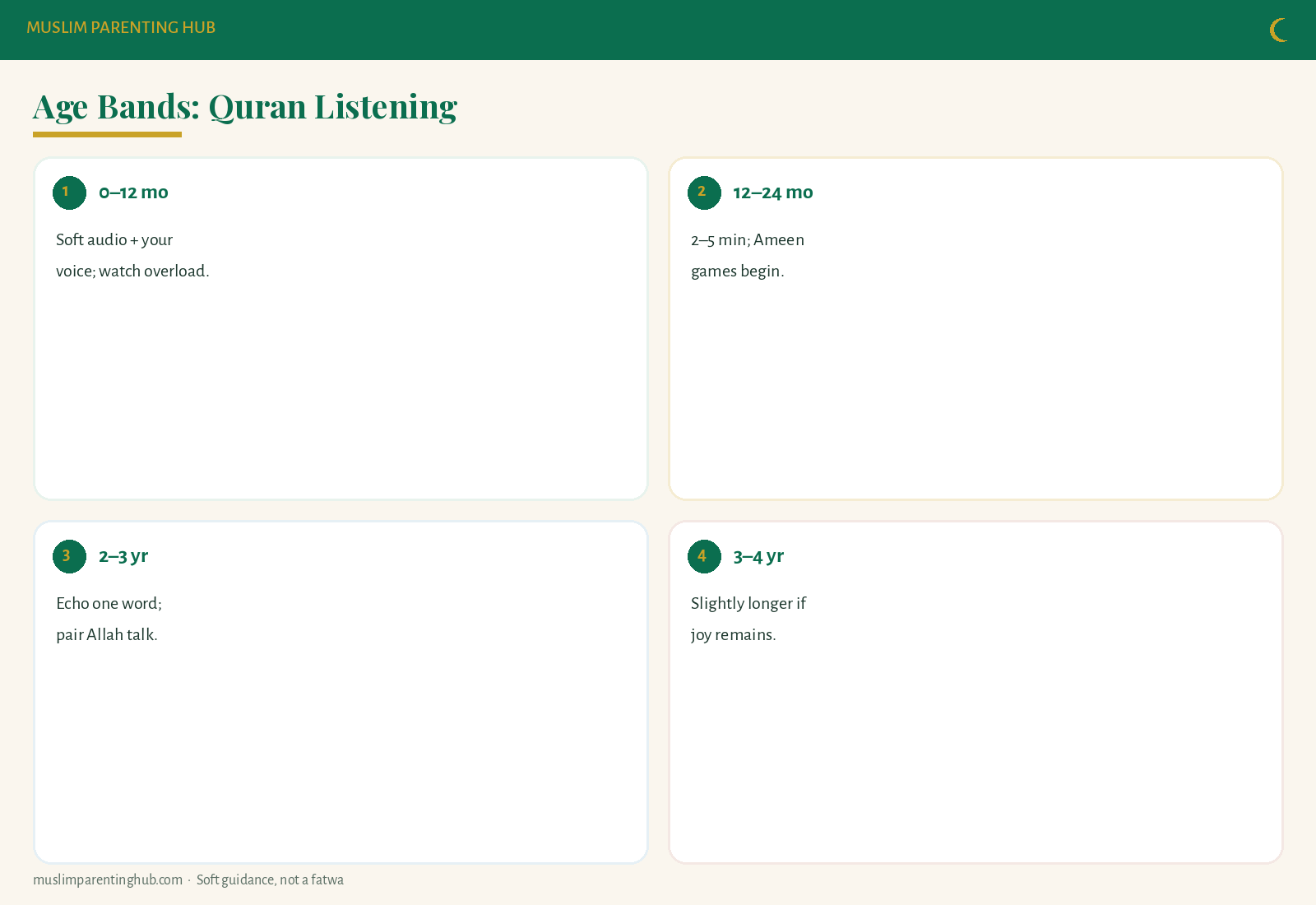
0–12 months
- Soft audio during nursing/quiet alert time
- Your voice reciting even one ayah is powerful
- Watch for overstimulation (gaze aversion, arching)—pause
12–24 months
- 2–5 minute sits nearby with toys that are quiet
- Celebrate any stillness or playful sway
- Begin “Ameen” games after Fatihah at home salah
2–3 years
- Invite echo of one easy word
- Picture mushaf for looking (with hand-clean coaching) while audio plays briefly
- Pair with Allah talk from Talk About Allah With Toddlers
3–4 years
- Slightly longer listens if joy remains
- Start noticing letters casually—still not forced Qaida grind
- Own-words dua after listening (Dua from the heart)
If They Run, Giggle, or Demand Cartoons
Normal. Revelation is majestic; toddlers are toddlers.
Try:
- Shorter clip (60–90 seconds)
- Your lap + whisper “listening ears”
- One physical cue (hand on heart)
- End while it’s still okay—leave them wanting the feeling again
Avoid:
- Forcing sit-still for 20 minutes
- Threatening “Allah will be angry if you move”
- Using Quran audio as a behavior cattle-prod all day until it loses meaning
If cartoons always win, fix the screen gate first—Deen before screen.
Listening ≠ Wallpaper
Playing Quran 18 hours on mute-ignore while chaos blares can teach hearts to tune out wahy.
Prefer intentional pockets: start together, listen a little, end with “Sadaqallahul-adheem” or a simple “Allah’s words—Alhamdulillah,” then move on.
House cleaning with soft Quran can be lovely if adults still show intermittent attention and respect.
Memorization Pressure: Park It
Some children echo early; others don’t. Neither proves piety.
When you want memorization later, choose a gentle teacher and tiny targets. For now, protect love. Bedtime can include one listened ayah plus a prophet story vibe later—without mixing too many new routines at once; keep sleep calm per Toddler bedtime fixes.
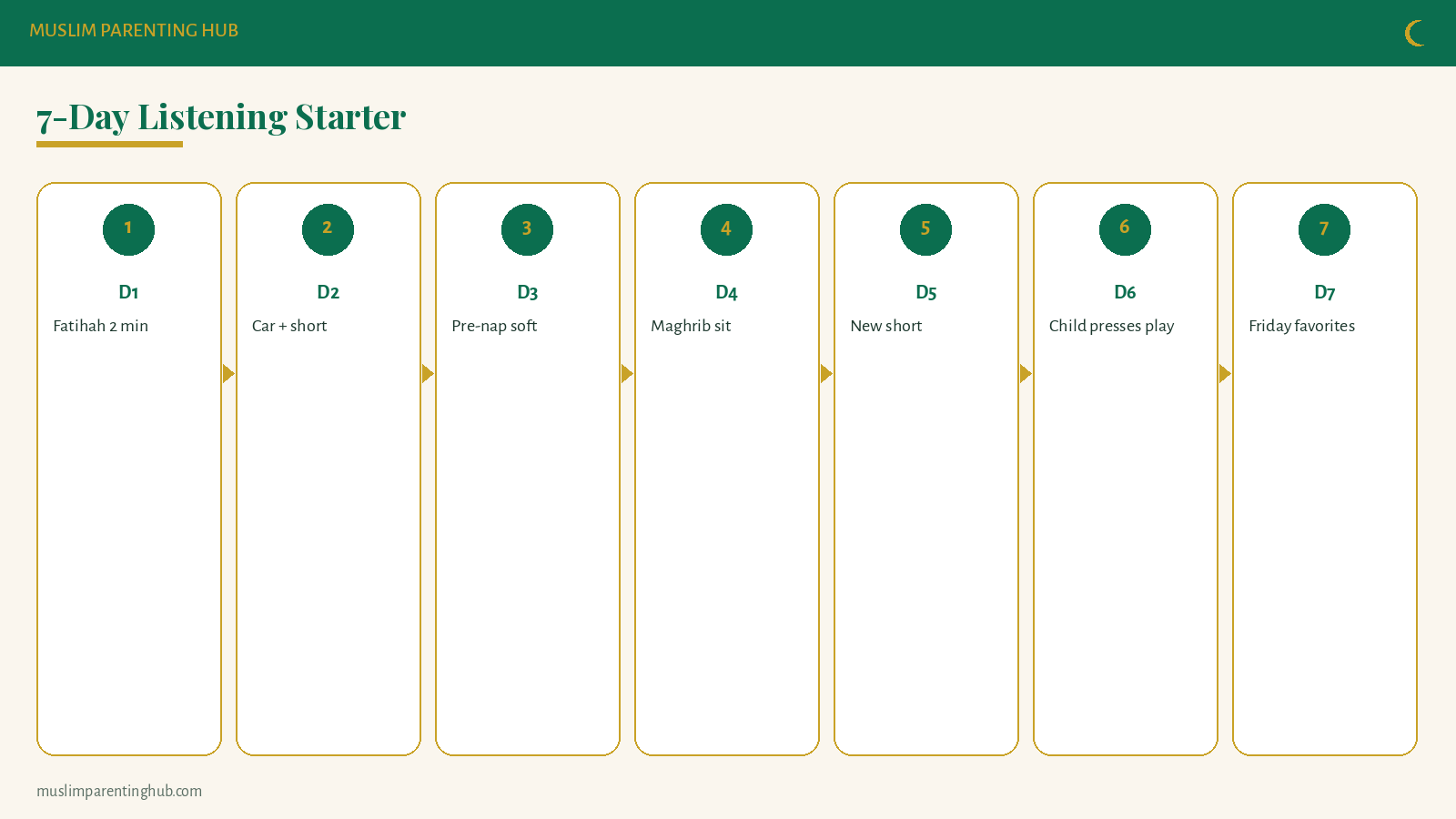
A 7-Day Listening Starter Plan
| Day | Minutes | Focus | |
|---|---|---|---|
| 1 | After breakfast | 2 | Al-Fatihah only |
| 2 | Car / stroller | 3 | Same + one short surah |
| 3 | Pre-nap | 2 | Soft familiar reciter |
| 4 | After Maghrib | 5 | Family sit, toys OK |
| 5 | Parent chooses | 3 | New short surah intro |
| 6 | Morning | 2 | Child presses play (helping) |
| 7 | Friday | 5 | Review favorites + gratitude |
Repeat the week. Consistency > novelty.
Home Edge Cases
Multiple kids / noise: Use headphones for the infant occasionally? Prefer open-air soft speaker so adab stays shared—headphones only if needed for special situations.
Non-Muslim household members: Explain briefly: “Sacred recitation—we keep it gentle.” Offer to use another room.
You don’t recite well: Audio + your humble attempts both count. Kids need your effort more than studio perfection.
Masjid FOMO: Home listening still counts. Bring them when ready; don’t shame.
Speech delay concerns: Quran listening is not speech therapy—but rhythmic exposure is generally fine. Follow pediatric guidance for overall development.
Pairing With Faith Cluster
- Talk about Allah with toddlers — meaning layer
- Angels without fear — unseen world soft entry
- Dua from the heart — response after listening
- Teach salam — living Islam in manners
Parent Recitation Confidence Ladder
- Play audio only while you sit present.
- Hum along softly on familiar surahs.
- Recite one ayah before audio.
- Alternate: you, then audio.
- Invite toddler echo on a single word.
Climb only while joy remains. Your accent is part of their love map.
Mushaf, Apps, and Touch Adab
For toddlers who want to “hold Quran”:
- Use a sturdy kids mushaf or approved app with large script
- Wipe hands first as a gentle habit (keep age-realistic)
- Teach kiss? Follow your family’s adab teachers—never fight over it
- If they throw pages, pause access, teach gentle hands, retry later
Digital mushaf reduces torn pages but increases screen temptation—lock exit to games.
Travel, Illness, and Inconsistent Weeks
Do not “catch up” with hour-long guilt sessions after travel. Resume the two-minute pocket. Quran relationship is a long marriage, not a missed homework packet.
During illness, your whispered Al-Fatihah near them may be the most powerful “lesson” of the year.
Signs Listening-First Is Working
- Child asks for “Allah words” or a surah nickname they invented
- Body softens when a familiar reciter starts
- Ameen appears at home salah
- Less battle than with cartoons (relative!)
Signs to adjust:
- Covering ears in distress (try new reciter/volume/time)
- Only clowning amplify—shorten drastically
- Parent resentment—shrink plan until love returns
From Listening to Early Learning (Bridge, Not Leap)
When they start noticing letters (often ~4–5+), keep listening pockets and add:
- Point to a big ا ب ت poster casually
- One Qaida page a few times a week with smiles
- Teacher one day a week if available
Never cancel beauty time only to grind drills. Parallel tracks beat replacement.
Car Kit Checklist
- Downloaded offline recitation (no surprise ads)
- Volume capped before engine starts
- Water / snack so hunger doesn’t sabotage
- One backup short playlist (Fatihah + 3 shorts)
- Rule: Quran playlist ≠ automatic gateway into cartoon playlist—use separate profiles
Road listening can become your family’s most consistent pocket if errands are frequent.
Sibling Differentiation
Older sibling memorizing? Protect the toddler from comparison. Give the older a teaching job: “Press play for your sister’s two-minute listen.” Service beats rivalry. If jealousy flares, use tools from Sibling jealousy.
Reciter Choice Without Endless Scrolling
Pick one primary reciter for 30 days so toddlers recognize the voice. Switching every night for “best tajweed debates” unsettles little listeners. Adults can study variant styles later; babies need familiarity.
If you only remember one rule: protect love of Quran first. Everything else—Qaida, memorization clubs, competitions—can wait until the sound of wahy feels like home.
Make dua for your child’s heart to love the Quran—parent dua is part of the plan, not an afterthought.
Keep sessions joyful enough that your child sometimes asks to start—that request is the real curriculum milestone.
FAQ: Quran for Infants & Toddlers
How do I introduce Quran to a baby?
Play short, soft recitation during calm windows like feeding or quiet alert time. Your own voice saying even one ayah matters. Watch for overstimulation and pause when needed.
How long should toddlers listen to Quran?
Often 2–5 minutes of intentional listening is enough. Longer is fine if they stay peaceful—stop before it becomes a battle.
Should I force my toddler to sit still for Quran?
No. Invite, shorten, and model. Forced stillness can poison love of Quran. Allow quiet toys if needed.
Which surahs are best for toddlers?
Start with Al-Fatihah and short surahs you love. Rotation beats a rigid syllabus at this age.
Is it okay to play Quran in the car?
Yes for many families—often better than random entertainment—if volume is moderate and you still engage respectfully at times.
When should Qaida or memorization start?
When interest and readiness appear—often preschool or later—with a gentle teacher. Listening-first can continue alongside early learning without pressure.
FAQs
How do I introduce Quran to a baby?
Play short soft recitation during calm windows like feeding or quiet alert time. Your own voice saying even one ayah matters; pause if the baby shows overstimulation.
How long should toddlers listen to Quran?
Often 2–5 minutes of intentional listening is enough. Longer is fine if they stay peaceful—stop before it becomes a battle.
Should I force my toddler to sit still for Quran?
No. Invite, shorten, and model. Forced stillness can poison love of Quran; quiet toys are okay.
Which surahs are best for toddlers?
Start with Al-Fatihah and short surahs you love. Rotation beats a rigid syllabus at this age.
Is it okay to play Quran in the car?
Yes for many families if volume is moderate and you still engage respectfully—often better than random entertainment.
When should Qaida or memorization start?
When interest and readiness appear—often preschool or later—with a gentle teacher. Listening-first can continue alongside early learning.