How to Talk About Allah With Toddlers: Simple Words That Stick
Toddlers do not need a theology class. They need warm words, repeated in real life, that make Allah feel close—not far, scary, or abstract.
If you have ever wondered what to say when your two-year-old points at the moon, spills juice, or asks “Who made that?”, this guide is for you. You will get tonight scripts, a 7-day micro plan, outdoor “creation talk” cues, and age notes for 0–12 months, 12–24 months, and 2–3 years. Soft Sunnah-inspired parenting—not a fatwa. Keep what fits your home; ask a trusted teacher for rulings.
The Big Idea: Name Allah in Ordinary Moments
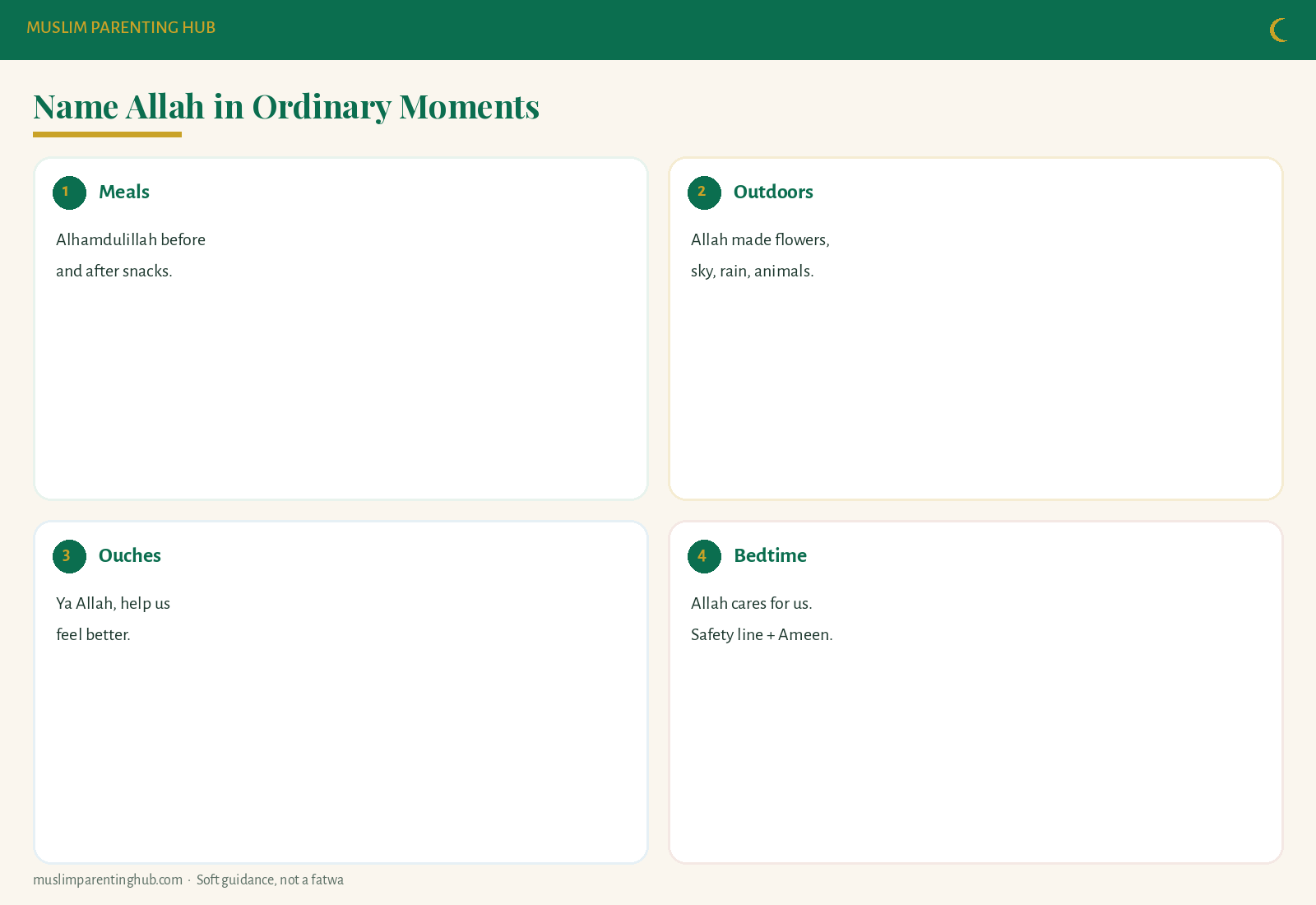
Faith for ages 0–3 is mostly association:
- Nice things → “Alhamdulillah / thank You, Allah.”
- Beautiful things → “Allah made this.”
- Hard moments → “Ya Allah, help us.”
- Safety → “Allah cares for us.”
Skip long lectures about attributes your toddler cannot hold. Prefer short, true sentences you can reuse a hundred times.
What Toddlers Can (and Cannot) Grasp
| Age | What lands | What to skip |
|---|---|---|
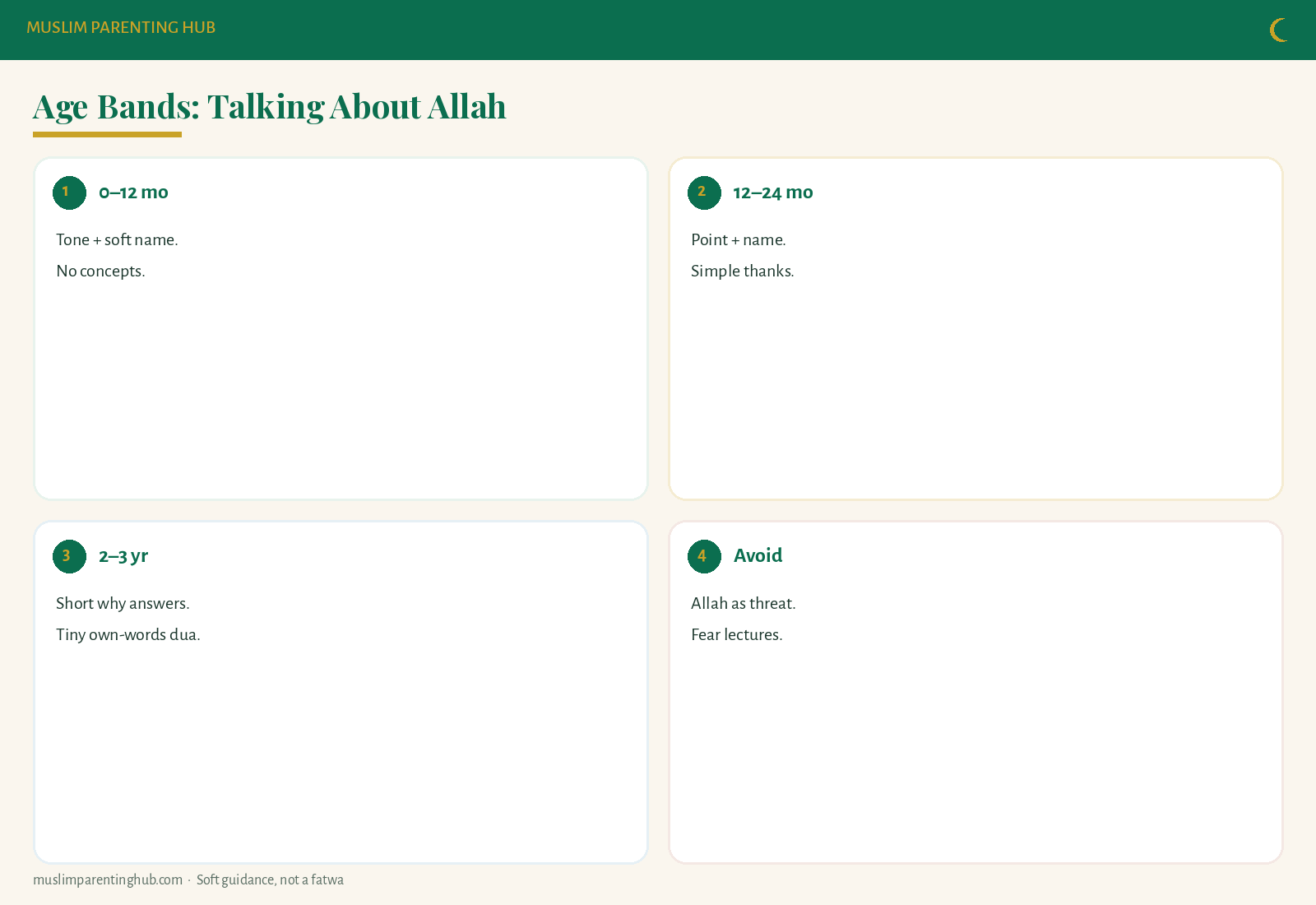
| 0–12 months | Tone, your calm voice saying Allah’s name, soft nasheed-free lullaby duas | Concepts, debates, fear stories |
| 12–24 months | Pointing + naming (“Allah made the bird”), simple Alhamdulillah after snacks | Abstract “why” theology |
| 2–3 years | Short why-answers, tiny own-words dua, noticing kindness as something Allah loves | Hell fire lectures, shaming, “Allah will be mad” as discipline |
Your face teaches more than your paragraph. Soft voice + smile when you say Allah’s name builds love.
Tonight Scripts You Can Copy
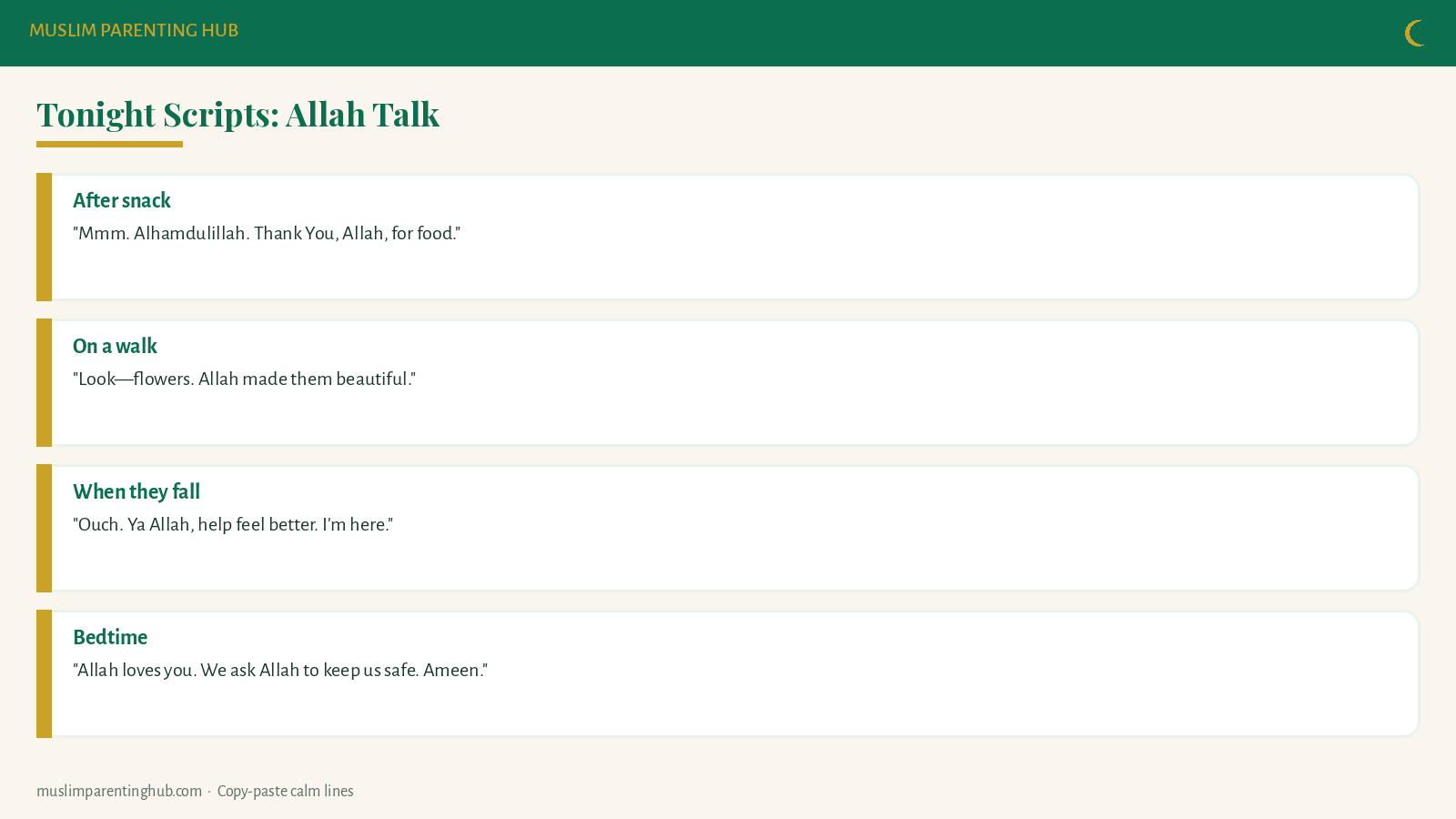
After a snack: “Mmm. Alhamdulillah. Thank You, Allah, for food.”
On a walk: “Look—flowers. Allah made them beautiful.”
When they fall: “Ouch. Ya Allah, help [name] feel better. I’m here.”
At bedtime: “Allah loves you. We ask Allah to keep us safe. Ameen.”
When they ask “Who?”: “Allah created us. Parents care for you; Allah cares for everyone.”
When they break something: “Accidents happen. We clean up. Allah loves when we try again.”
Avoid: “Allah hates you when you…” / “Allah will punish you if…” for toddler discipline. That wires fear, not love. Boundaries still matter—own them as the parent (“Hitting stops”) without outsourcing anger to Allah.
The Everyday Allah Reflex (Build It in 7 Days)
A reflex is a short phrase that becomes automatic. Pick one primary reflex for the week:
Primary: “Alhamdulillah” after ordinary goods (food, play, reunion).
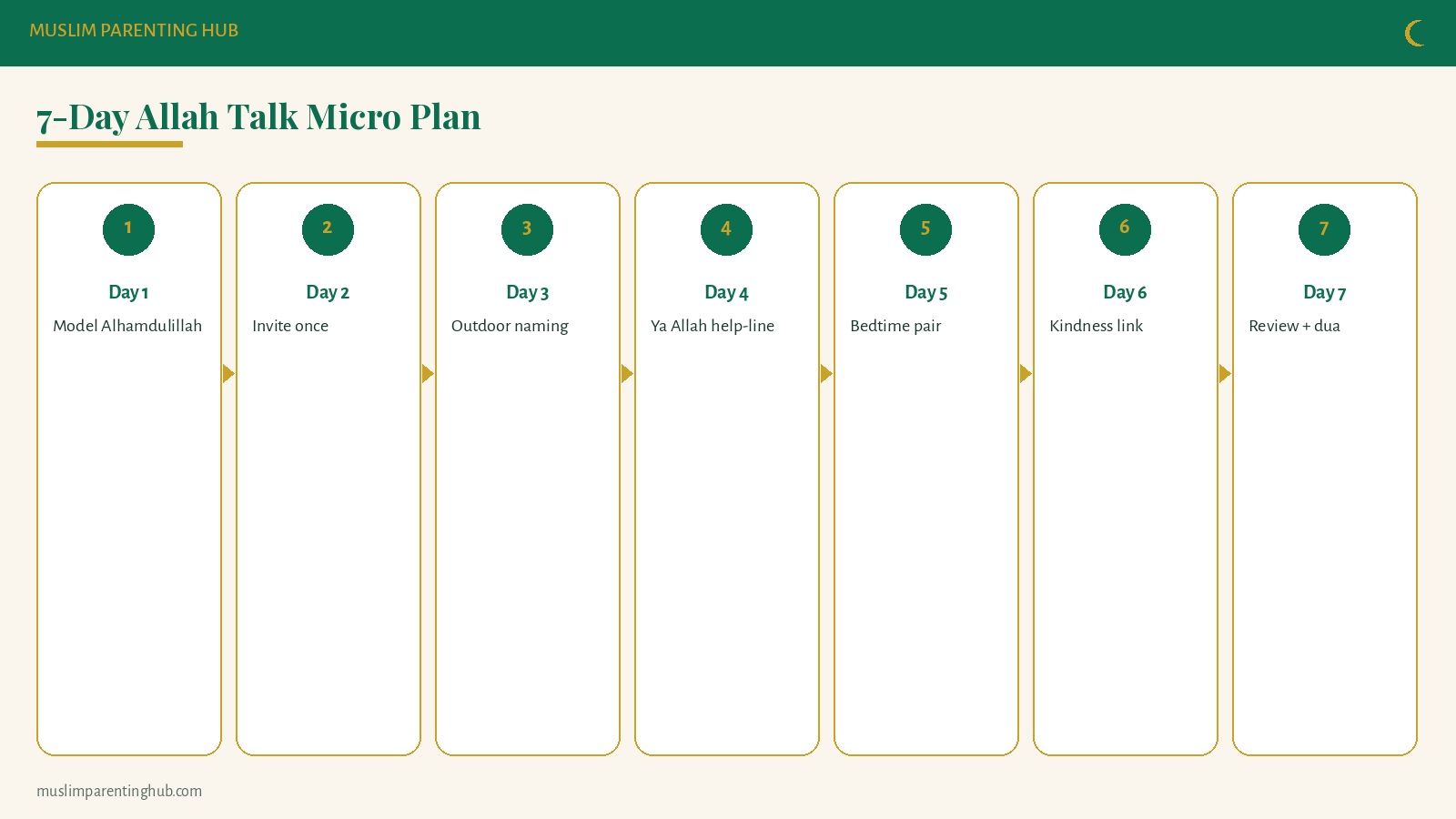
7-day micro plan
- Day 1 — Model only. You say Alhamdulillah 10+ times; no pressure on the child.
- Day 2 — Invite once. After juice: “Can you say Alhamdulillah with me?” Accept a mumble.
- Day 3 — Outdoor naming. Three “Allah made…” sentences on a walk or balcony.
- Day 4 — Help-line. One “Ya Allah, help us” during a tough transition (shoes, car seat).
- Day 5 — Bedtime pair. Story or cuddle + one safety line about Allah’s care. Pair with calm nights from Toddler Bedtime Fixes.
- Day 6 — Kindness link. “Allah loves kindness. Let’s share one toy.” Soft rahma, not a quiz.
- Day 7 — Review joy. Tell your toddler: “This week we remembered Allah. That makes my heart happy.” Make a tiny dua together—grow later with Dua From the Heart.
Keep each day’s “lesson” under two minutes. Repetition across weeks beats one big talk.
Creation Talk Outdoors (Without a Lecture)
Nature is the toddler madrasa.
Walk cues:
- Sky / clouds → “Allah made the sky wide.”
- Rain → “Allah sends rain. Plants drink. Alhamdulillah.”
- Animals → “Allah made animals different—wow.”
- Your child’s hands → “Allah gave you hands to help and hug.”
Home cues:
- Light switch → “Allah gave us minds to invent lights—still, light itself is a gift we use carefully.” (Keep ultra-simple: “Light helps us. Alhamdulillah.”)
- Food colors → name colors, then one Allah line.
If your child is sensory-seeking, let them touch bark or water while you speak. Words + sensory = memory.
Age Bands in Detail
Infants (0–12 months)
Narrate like a gentle audiobook: “Allah gave you warm milk. Mama/Baba is here.” They absorb rhythm and emotional tone. Play soft Quran listening in calm windows—see Quran Listening for Infants & Toddlers when you want an audio plan. No quizzes. No volume wars.
Young toddlers (12–24 months)
They point; you name. They dump toys; you reset with “Ya Allah, help us tidy.” Celebrate any echo of “Alham…”. Connect manners seeds to peace greetings in Teach Toddlers to Say Salam.
Older toddlers (2–3 years)
Expect “why” loops. Answer in one sentence, then redirect to play:
Child: “Why did Allah make bugs?”
You: “Allah made many creatures. Some help the earth. Want to watch this ant walk?”
If they fear thunder: “Loud sky. You’re safe with me. Ya Allah, keep us calm.”
Home Edge Cases
Non-Muslim relatives present: Keep your lines natural, not performative. “We say Alhamdulillah—it means thanking God.” No toddler debate club.
Meltdowns in public: Regulate first (hold, breathe), then a whisper dua. Faith talk mid-scream rarely lands.
You feel spiritually dry: Still model one sentence. Children need consistency more than your perfect state.
Sibling noise: One-on-one micro moments beat family lectures. Even ninety seconds after nap matters. For jealousy dynamics, see Sibling Jealousy in a Muslim Home.
Screens competing for awe: Protect morning and Maghrib windows so wonder isn’t only digital—pair with Deen Before Screen and After-School Maghrib Routine.
What Not to Do (Toddler Edition)
- Don’t use Allah as a threat to force vegetables or silence.
- Don’t flood with Arabic terms they cannot map—add meanings slowly.
- Don’t correct harshly if they mispronounce Allah’s name; model kindly.
- Don’t turn every second into a sermon—joy and play are also worshipful when done with gratitude.
- Don’t compare “Sister’s toddler already says SubhanAllah.” Timelines differ.
A Mini “Allah Jar” Activity (Ages 2–3)
Keep a small jar and paper slips. Each evening, dictate one blessing your toddler names (“banana,” “Papa,” “swing”). Write it, drop it in, say Alhamdulillah. Once a week, pull three slips and reread. Visual gratitude prepares later shukr habits without worksheets.
Linking Faith Talk to Angels and Dua (Gently)
When your child is ready for more “unseen” warmth—not fear—browse Teach Kids About Angels Without Scaring Them. Keep angels as care and obedience to Allah, never Halloween energy.
Own-words dua grows naturally from “Ya Allah, help…” lines above—deepen with the dua guide when they turn three or four.
Parent Heart Check
You are not behind if your toddler only hears Allah’s name at meals. You are planting. The Prophet ﷺ’s mercy with children reminds us that gentleness is not optional decoration—it is the method. Show up soft, repeat often, repair when you snap.
Tonight: pick one script. Say it three times before bed. That is enough.
Sample Day: Allah Talk Without a Curriculum Binder
Morning: Wake with salam and “Allah gave us a new day—Alhamdulillah.” Water, bathroom, then your deen-before-screen gate if you use one.
Mid-morning play: Narrate two creations you see (light, bird, sibling’s smile). Stop. Return to play.
Lunch: One Alhamdulillah before and after. If they refuse to echo, you still model.
Afternoon dip: During crankiness, whisper “Ya Allah, help our hearts feel soft,” while offering a snack—not a lecture.
Maghrib window: One line after prayer: “We talked to Allah. He hears us.” Keep it warm.
Bedtime: Safety line + kiss. No quiz (“Who created the stars?”) when eyelids droop—save wonder for daytime.
This sample day is about density of love, not counting phrases with a clipboard.
Multilingual & Convert Homes
If Arabic is new to you, you are not disqualified. Learn one phrase a week with meaning. Children smell sincerity. Converts sometimes fear “doing it wrong”—choose a local teacher for aqidah questions, and keep toddler talk simple: Creator, thanks, help, love, safety.
If grandparents use different phrases (SubhanAllah vs. Mashallah habits), pick a home default so the toddler isn’t corrected by three adults for synonyms.
When Your Toddler Says Something Theologically Off
They will. “Allah is in the lamp.” “Allah is sleepy.” Smile. Redirect: “Allah is not like us. Allah created the lamp. Allah doesn’t sleep—He watches over us.” One correction, then move on. Deep aqidah belongs later with qualified teaching.
If they heard a scary video online about punishment, decompress: “Some videos are not for kids. Allah’s mercy is vast. You’re safe. Ask me, not the tablet.” Then tighten filters.
Measuring Progress (Without Turning Faith Into KPIs)
Look for:
- Spontaneous Alhamdulillah after something good
- Turning to you for a “Ya Allah” when hurt
- Soft face when hearing Allah’s name
- Curiosity outdoors
Do not look for:
- Perfect pronunciation on command for guests
- Quote recitation to impress relatives
- Fear-based obedience
Progress is relational.
Outdoor “Wonder Walk” Card (Keep in the Stroller)
Print or rewrite on an index card:
- Point to one living thing → “Allah made it.”
- Point to one sky thing → “Allah made the sky.”
- Name one body gift → “Allah gave you ears to hear.”
- End with Alhamdulillah + water sip.
Three minutes. No worksheet. Do it twice a week. Wonder walks beat indoor lectures because toddlers’ brains light up with movement and sensory input—the faith line rides along for free.
If weather traps you inside, do a “window wonder”: clouds, rain streaks, moon at Maghrib.
When Parents Disagree on Faith Talk Tone
One parent fears “too much religion”; the other fears “too little.” Agree on a minimum viable practice: Alhamdulillah at meals + one bedtime safety line. Anything beyond is bonus. Unity on the floor matters more than winning the philosophy argument at midnight.
FAQ: Talking About Allah With Toddlers
How do I talk about Allah with a 2-year-old?
Use short lines in real moments: “Allah made the moon,” “Alhamdulillah for snack,” “Ya Allah, help us.” Skip abstract lectures. Repeat the same phrases daily.
What should I say if my toddler asks who created everything?
A simple answer works: “Allah created us and everything. Parents take care of you; Allah takes care of all creation.” Then return to play.
Is it okay to speak about Allah only in English?
Yes for early years if that is your home language. Add Arabic names and phrases gradually with meaning. Clarity and love matter more than perfect bilingual performance.
How do I avoid making my toddler fear Allah?
Never use Allah as a threat for ordinary misbehavior. Emphasize care, thanks, help, and safety. Hold boundaries yourself with calm firmness.
Can infants benefit from hearing about Allah?
Yes—through tone and repetition. Soft duas, calm Quran listening, and warm narration build familiarity long before speech.
What if my toddler repeats Allah’s name as a joke?
Gently reset: “We say Allah’s name with love.” Redirect to a sincere Alhamdulillah moment. Avoid shaming.
FAQs
How do I talk about Allah with a 2-year-old?
Use short lines in real moments: Allah made the moon, Alhamdulillah for snack, Ya Allah help us. Skip abstract lectures and repeat the same phrases daily.
What should I say if my toddler asks who created everything?
Say Allah created us and everything; parents care for you and Allah cares for all creation—then return to play.
Is it okay to speak about Allah only in English?
Yes in early years if that is your home language. Add Arabic names gradually with meaning; clarity and love matter most.
How do I avoid making my toddler fear Allah?
Never use Allah as a threat for ordinary misbehavior. Emphasize care, thanks, help, and safety while you hold calm boundaries.
Can infants benefit from hearing about Allah?
Yes through tone and repetition—soft duas, calm Quran listening, and warm narration build familiarity before speech.
What if my toddler repeats Allah’s name as a joke?
Gently reset that we say Allah’s name with love, redirect to a sincere Alhamdulillah moment, and avoid shaming.